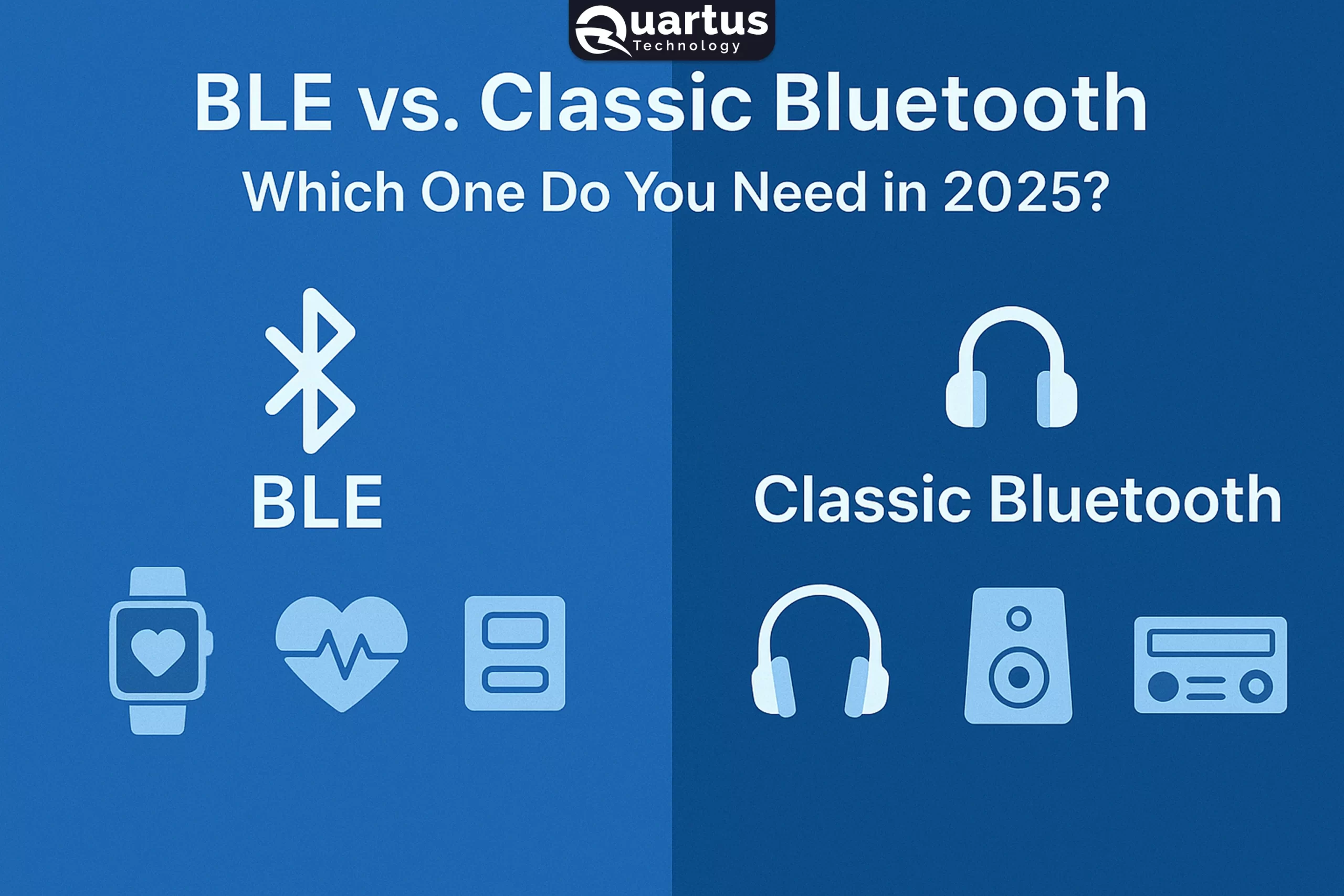
When it comes to wireless communication, Bluetooth has been a household name for decades. From connecting headsets and speakers to syncing smart devices, Bluetooth has become the backbone of short-range connectivity. But as technology evolves, a newer version—Bluetooth Low Energy (BLE)—is taking the spotlight.
In 2025, businesses and developers often face a critical question: Should I use BLE or Classic Bluetooth for my application? Let’s break down the differences, use cases, and the right choice for your needs.
What is Classic Bluetooth?
Classic Bluetooth, introduced in 1999, is designed for continuous wireless streaming. It offers higher data transfer rates and has long been the go-to technology for audio devices like headphones, speakers, and car infotainment systems.
- Data Rate: Up to 2–3 Mbps
- Power Consumption: Relatively high, drains battery faster
- Range: Typically 10–100 meters
- Best For: Audio streaming, file transfer, gaming controllers
What is BLE (Bluetooth Low Energy)?
BLE was introduced in 2010 (Bluetooth 4.0) and optimized for low power consumption. Instead of continuous streaming, BLE works in quick bursts, making it perfect for devices that need to send small amounts of data occasionally while saving battery.
- Data Rate: Up to 1 Mbps (Bluetooth 5+ allows faster speeds)
- Power Consumption: Extremely low, optimized for long battery life
- Range: Up to 100–400 meters (with Bluetooth 5.3 in 2025)
- Best For: IoT devices, healthcare sensors, wearables, POS systems, asset tracking
BLE vs. Classic Bluetooth: Key Differences
| Feature | Classic Bluetooth | BLE (Bluetooth Low Energy) |
|---|---|---|
| Power Usage | High (battery drains faster) | Ultra-low (ideal for long-term use) |
| Data Transfer | High speed, continuous | Small packets, periodic |
| Range | 10–100 meters | Up to 400 meters with BT 5+ |
| Use Cases | Audio streaming, file sharing | IoT, healthcare, smart devices |
| Connection Time | Slower to connect | Faster pairing, low latency |
| Cost | Slightly higher | Cost-efficient for IoT |
Which One Should You Choose in 2025?
Choose Classic Bluetooth if:
- You need continuous audio streaming (headphones, speakers, car audio).
- Your application demands higher data transfer rates.
- Power consumption is not your top priority (devices that recharge often).
Choose BLE if:
- You are building IoT applications like smart locks, wearables, or healthcare monitors.
- Your device needs to last months or years on a single battery.
- You need scalability with multiple devices connected at once (e.g., POS systems, smart homes).
The Future of Bluetooth in 2025
With the advancements of Bluetooth 5.3, BLE has become even more reliable, offering extended range, higher speeds, and better coexistence with Wi-Fi. Classic Bluetooth still dominates the audio streaming industry, but BLE is clearly leading the IoT revolution.
Businesses in retail, healthcare, and logistics are rapidly adopting BLE for low-cost, high-efficiency connectivity. If your focus is on scalable, power-efficient, and future-ready solutions, BLE is the way forward.
Conclusion
In 2025, the choice between Classic Bluetooth and BLE depends on your application’s needs. Classic Bluetooth is best for continuous, high-speed streaming, while BLE shines in low-power, long-lasting IoT and mobile applications.
At QuartusTech, we specialize in building BLE-powered mobile, web, and enterprise applications that connect the future. Whether you’re building the next smart wearable, POS system, or IoT ecosystem, BLE ensures your solution is efficient, scalable, and future-proof.